
You’ve seen, heard, and read enough to be convinced strength training belongs in your life, including in “Ask a Personal Trainer: The Case for Lifting in Midlife.” Now what?
First, check in with your healthcare professional before starting any physical exercise program. Once you have the green light, build over time. You don’t need a gym or to work out every single day to see results.
Personal trainer Salene Parnese (@womenshealthnation) works with clients throughout the New York metropolitan area and specializes in fitness for midlife women. We asked her to cut through the noise and explain which exercises matter most, and why.
Will strength training help me look better?
Yes, you will definitely look better, but I think that’s one of the smallest benefits of strength training. Also yes, it can absolutely help reduce body fat when you combine it with proper nutrition, and yes, it can also help reduce your abdominal fat over time.1 But it’s important to remember that you can’t spot reduce from one specific area.2 Fat loss happens throughout the body, and where we lose it first is usually determined by genetics and hormones.
As you build and maintain lean muscle and reduce body fat, your body composition will change. You may not notice a huge difference on the scale, but you’ll notice your clothes fit differently, your waistline changes, you carry yourself differently, and you feel stronger and more confident. I always encourage women not to rely solely on the scale. Your body can change in really positive ways even if the number on the scale doesn’t move, and sometimes it goes up.
Strength training has incredible functional benefits. It literally makes everyday life easier. Like I said before: carrying groceries, lifting your suitcase overhead, climbing stairs, getting up and down off the floor, balance, it all improves with strength training.3 And your energy starts to go up.
As far as when you’ll notice changes, you’ll often begin feeling stronger before you see a dramatic physical change. Building muscle and changing your body composition takes time. Every workout is an investment in your future health. And while looking better is a wonderful bonus, I don’t want that to be the only reason women strength train. I want them to train because I want them to feel stronger, be stronger, move better, protect their bones, maintain their independence, and continue doing the things they love for decades to come. That is the real transformation for me.
What are the exercises I actually need?
We want to focus on movements that give us the biggest return on our time. The good news is you don’t need a gym. You can do all the movements I’m going to tell you about at home. You can use different modalities: dumbbells, bands, kettlebells, if you’re in a gym, machines, and sometimes your body weight; they’re simply different tools. It’s consistently performing these fundamental movement patterns and progressively challenging your muscles over time that makes the difference.
When I design a full body program, I focus on 7 primary movement patterns. A sample might look like this:
1) A squat variation, which is a body weight squat, a barbell squat, even a leg press if you’re in the gym.
2) A hip hinge: a deadlift, a Romanian or a conventional, a kettlebell swing, a hip thrust.
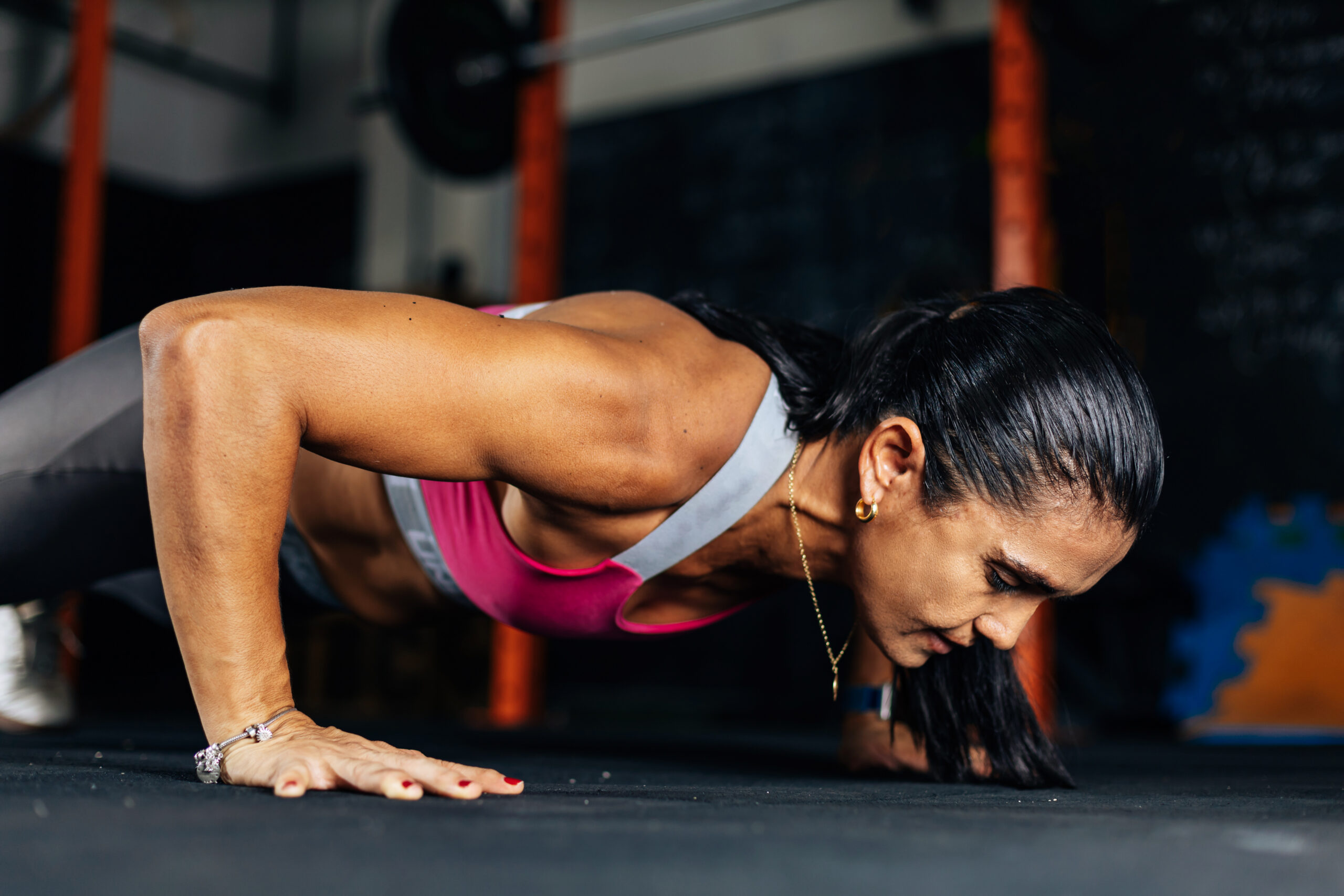
3) Moving on to upper body, a horizontal push: a push up, a bench press, a chest press.
4) Also a vertical push, this would be like a shoulder press or a handstand pushup.
5) Then we move into the pull. This would be a horizontal pull, which is a seated row or a bent over row,
6) Also a vertical pull, which would be something like a lat pull down or an assisted pull up.
7) Then I always include some type of core bracing, because a strong core supports everything we do. This would be something like a dead bug, a plank, an ab wheel rollout, a Pallof press.
If you’re short on time, don’t overcomplicate. Build your workout around these 7 fundamental movement patterns and train them consistently.
By consistently including these movement patterns in your training, you’re working all your major muscle groups and building strength. I will always remind people that there isn’t one perfect exercise: a squat isn’t better than a leg press, and free weights aren’t better than machines. What’s best is what’s appropriate for your body, your experience level, and your goals, and you want to challenge yourself safely and with good technique.
What’s one more thing you wish every midlife woman knew about strength training?
I wish every woman knew this isn’t really about the muscle. Yes, you’ll become physically stronger, but what happens outside the gym is even more powerful. Strength training teaches you discipline. It teaches patience, resilience, humility, and confidence. It reminds you that you’re capable of doing hard things. Every time you pick up a weight you once thought was impossible, you begin to realize that you’re capable of so much more than you ever gave yourself credit for.
I truly believe strength training is one of the greatest gifts a woman could give herself. I often call it the closest thing we have to the fountain of youth, not because it stops aging, but because it helps us age with strength, confidence, independence, and vitality.
I also think there’s something incredibly empowering about strength training during midlife. Society often tells women that after a certain age, we should become smaller, quieter, and somehow accept that we’re declining. I don’t believe that for a second. In fact, some of the strongest, most disciplined, and most inspiring women I know are over 50. They’re still learning, still growing, still challenging themselves, and proving that strength has no expiration date.
If there’s one thing I hope every woman takes away, it’s this: don’t let your age define what you believe you’re capable of. Your body is still adaptable, your mind is still powerful, and it’s never too late to become stronger than you were yesterday.
This is not medical advice. Check in with your healthcare provider before starting a new exercise or strength training program, especially if you’re planning to lift heavy weights.
Supporting research behind Parnese’s responses.
1. Khalafi, M., et al. (2023). Frontiers in Endocrinology. Systematic review and meta-analysis of 101 studies involving 5,697 postmenopausal women, finding that exercise training, including resistance training, improved body composition by reducing fat mass, body fat percentage, visceral fat, and waist circumference while increasing lean body mass.
2. Ramirez-Campillo, R., et al. (2021). Human Movement. Systematic review and meta-analysis of 13 studies involving 1,158 participants, finding no significant difference in localized fat loss between trained and untrained limbs, directly testing and rejecting the spot-reduction hypothesis.
3. Zhou, Y., et al. (2026). Frontiers in Public Health. Systematic review and meta-analysis of 12 randomized controlled trials involving 518 older women, finding resistance training improved handgrip strength, gait speed, Timed Up and Go performance, and 30-Second Chair Stand performance.