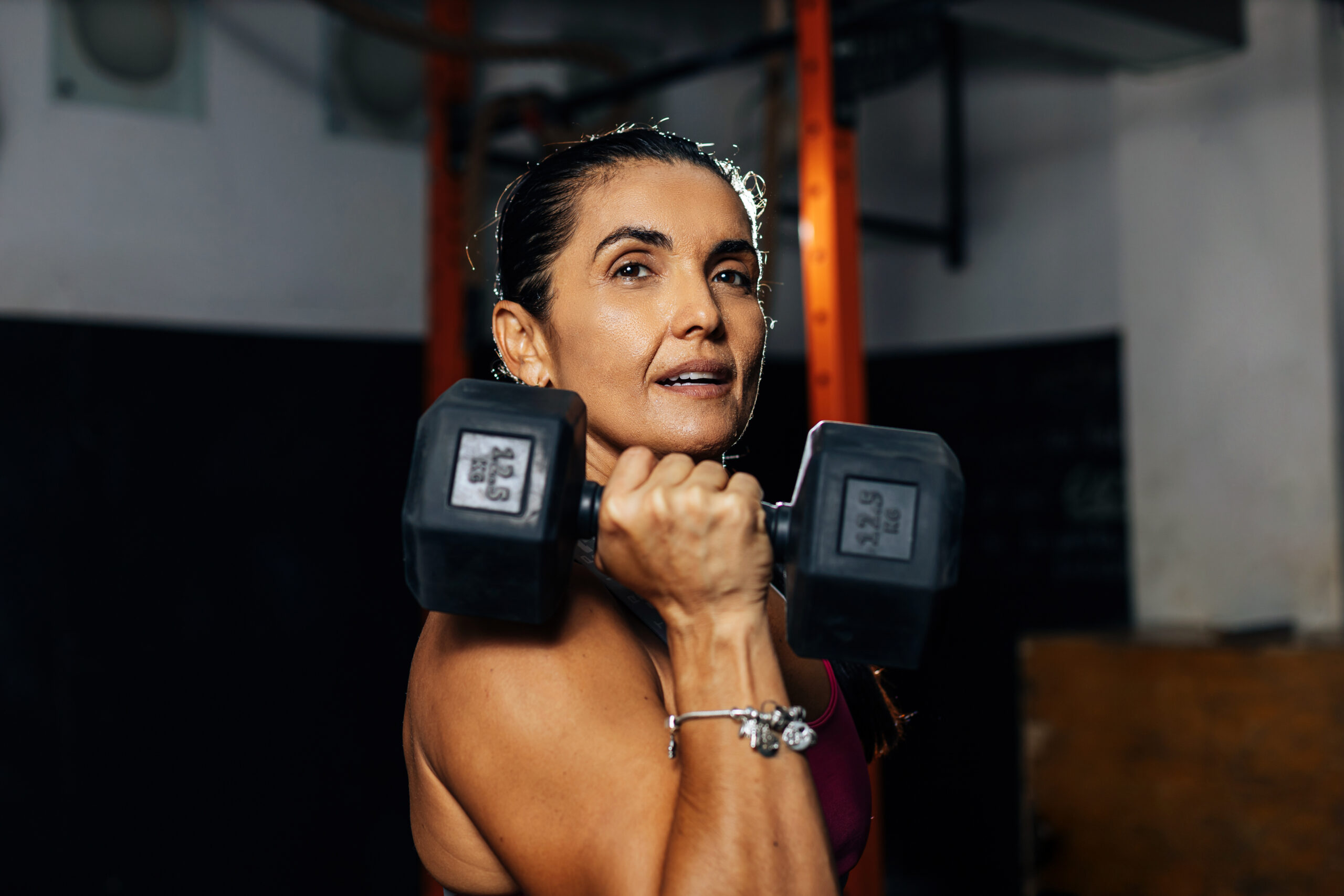

Everywhere you turn, someone is talking about strength training. It’s one of the biggest topics in women’s health right now, especially during perimenopause and menopause. How much of the conversation is backed by science, and how much is social media hype?
We reached out to highly regarded personal trainer Salene Parnese (@womenshealthnation) for answers. Parnese works with clients throughout the New York metropolitan area and specializes in fitness for midlife women. Between training sessions, she’s also active in organizations that support women’s initiatives, dog fostering, and pet adoption.
We asked Parnese the questions we hear most often from women in midlife, from whether strength training is really necessary to how heavy you should be lifting and whether it’s still possible to build muscle after menopause.
Do we really need to lift weights now?
My answer is yes, but not because you need to all of a sudden change everything once you reach perimenopause or menopause. Strength training has always been important, and will always be important.
It’s most important during this stage of life because our bodies are changing. As estrogen declines, we naturally begin to lose muscle more rapidly, and the rate of bone loss accelerates. This is a normal part of aging, but it doesn’t mean we’re powerless. In fact, strength training is one of the most effective things we can do to slow those changes, and in many cases even improve them. If we don’t regularly challenge our muscles with resistance, we gradually lose strength over time.
This doesn’t just affect how we look; it affects how we live. Everyday things like carrying groceries, lifting a suitcase into the overhead bin, getting down on the floor and getting back up again, climbing stairs, even maintaining balance, all become more difficult.
Strength training also helps stimulate bone remodeling, which is very important at this stage.1 Ultimately, strength training helps us stay strong, independent, and active as we age.2
I also want to say this, because it comes up a lot: I love walking and I encourage all of my clients to walk. It is absolutely wonderful for overall health: it reduces stress, it improves mood, and when done at a brisk enough pace, it can absolutely contribute to cardiovascular fitness. But walking isn’t a substitute for strength training, and depending on the intensity, it may not replace dedicated cardiovascular exercise either.
Strength training provides the resistance your muscles and bones need to stay strong, and cardiovascular exercise challenges your heart and lungs. Ideally, we want all of this in a well-rounded fitness routine.
When women ask me if it’s really worth fitting strength training into an already busy schedule, my answer is yes, yes, yes, yes, yes.
I don’t see it as another item on your to-do list; I see it as one of the greatest investments you can make in your future health, because at the end of the day, strength isn’t just about building muscle. It’s about building a life that allows you to continue doing the things you love for years to come.
How much strength training is enough?
One of the biggest misconceptions is that you have to spend hours in the gym every day to see results, and honestly, you don’t. For most women in perimenopause and menopause, I recommend strength training 2 to 4 days per week.
Two days minimum is what I recommend for building and maintaining strength, muscle, and bone health.
Your workouts don’t have to be long either. Most sessions can be completed in 30 to 60 minutes. And if you’re training efficiently and staying focused, and you’re more experienced and comfortable with your exercises, you can absolutely get a great workout in 40 minutes. I’d much rather see someone in a completely focused, intentional workout in 30 to 40 minutes than wandering around the gym for 90.
And then also, full body workouts, are they enough? They absolutely are. If you’re only going to train 2 or 3 days a week, full body workouts are more efficient and effective, and you don’t have to follow a complicated body parts split. And recovery, when you’re doing a full body workout, is generally training every other day, or having a couple of days in between, so those muscles have time to recover and adapt. If you’re following a split routine and training different muscle groups on different days, you can train more frequently because you don’t need to worry about training the same muscles each day.
Recovery isn’t just about a day off. It’s prioritizing sleep, staying hydrated, taking rest days when you need them, and also moving your body on those days. I call them active rest. I encourage people to walk on those days, do mobility work, stretch. Just because you’re not doing a strength workout that’s in your schedule doesn’t mean you should stop moving. And managing stress is extremely important.
At the end of the day, exercise should fit into your life. It shouldn’t become your life. And my goal is not to give women the most demanding program, it’s to give them a sustainable one, because if you can’t stick with the routine consistently, what good is it? You want the routine that you will stick to consistently, and that’s the one that will give you the best long-term results.
How heavy should I be lifting?
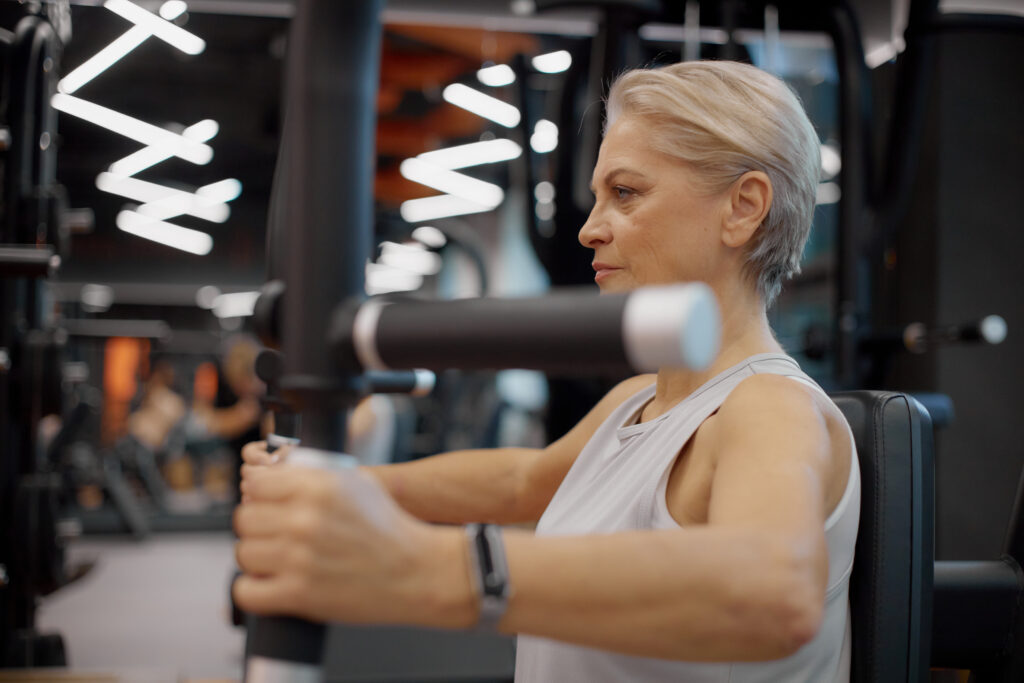
This is such an important question because lifting heavy is truly relative. What’s heavy for one person could be light for someone else. We want to choose a weight that’s appropriately challenging for you. If I’m working with a beginner or someone who’s never strength trained before, I spend the first several weeks teaching proper movement patterns and technique and building a solid foundation. Once that foundation is in place, we gradually start increasing the load.
For more experienced lifters and clients, I program one primary strength move. This is a compound movement: a squat, a deadlift, a press. It’s a lower rep range, generally 6 to 8 reps, and the weight should be heavy enough that the last 2 reps are a struggle, but you’re still maintaining good form. The accessory exercises that follow are the same: generally a slightly higher rep range, maybe 10, 12, 15. The goal is the same: you shouldn’t be breezing through the set. Last 2 reps should feel hard.
One of the biggest mistakes I see is women using the same weights for months, even years.
If you can easily complete every rep and still feel like you could do several more, your body is no longer being challenged.
This is your cue to gradually increase that weight. Progressive overload, it’s asking your muscles to do a little more over time. This is how we continue to build strength.
Lifting heavy at 45 or 50 is absolutely safe when you’re using proper technique and progressing appropriately. I would go one step further and say it’s one of the most important things women could do during perimenopause and menopause. Personally, if I had to choose, I’d much rather see women prioritize progressive strength training than spend all of their time doing endless cardio classes, circuit training. These workouts have their place, but when it comes to maintaining muscle and protecting bone density, aging well, all of that, strength training is the foundation. The goal is to lift a weight that’s challenging for you, continue progressing over time, and always prioritize quality movement. This is how we build strength safely and effectively.
Can I build muscle after menopause?
I am very excited about this question. Yes, absolutely, you can build muscle after menopause. In fact, this is one of the biggest myths that I enjoy busting. So many women believe that once they reach menopause, it’s impossible to build muscle. And the good news is that newer research is changing that conversation, and this is thrilling news.
Muscle loss is not inevitable. Recent research suggests there isn’t a meaningful difference in the ability of pre-menopausal and post-menopausal women to gain strength and build muscle through resistance training.3 In other words, menopause itself isn’t the roadblock many women think it is. Yay! This is very exciting for me.
The same general principles that help build muscle at 35 are also going to help build muscle at 55. What matters most is having a program that’s appropriately challenging for you. You want to challenge your muscles consistently and allow your body enough time to recover.
Your age doesn’t determine your potential nearly as much as your habits do.
I tell my clients there are 4 pillars to building muscle at any age: strength training consistently; eating enough protein to support muscle repair and growth4; making sure you’re eating enough overall, in general. This is a big one because a lot of women unintentionally undereat, and if your body doesn’t have enough energy, it’s not going to be able to perform; and the 4th one is sleep and recovery. You’ve got to prioritize this.
Most women will begin feeling stronger within the first few weeks because their nervous system is becoming more efficient. Visible muscle changes take longer, so you have to be patient and think in terms of months rather than weeks. It isn’t a quick fix, building muscle. It’s a result of showing up consistently over time. And if you’ve never lifted weights before, you’ll actually see improvements much more quickly because your body is responding to a completely new stimulus.
I think one of the most empowering things women can hear is this: your muscles don’t know how old you are. They respond to the demands you place on them. Menopause doesn’t mean your strongest years are behind you. With consistent training, adequate protein, overall nutrition, quality sleep, and proper recovery, you can absolutely become stronger, build muscle, and improve your health at any age. This is very exciting news.
This is not medical advice. Check in with your healthcare provider before starting a new exercise or strength training program, especially if you’re planning to lift heavy weights.
Supporting research behind Parnese’s responses.
1. Watson et al. (2018), Journal of Bone and Mineral Research, on the LIFTMOR randomized controlled trial, which found that high-intensity resistance training significantly improved bone mineral density at the lumbar spine and femoral neck in postmenopausal women with low bone mass.
2. Zhou et al. (2026), Frontiers in Public Health, on a systematic review and meta-analysis of 12 randomized controlled trials and 518 older women, finding resistance training significantly improved handgrip strength, gait speed, and functional measures including Timed Up and Go and 30-Second Chair Stand performance.
3. Isenmann et al. (2026), Journal of Science and Medicine in Sport, on a systematic review and meta-analysis of 126 studies and 4,019 women finding no significant subgroup difference in strength or body composition gains between pre- and postmenopausal women.
4. Ribeiro et al. (2025), Journal of Strength and Conditioning Research, on a study of 97 previously untrained older women completing 24 weeks of resistance training, finding a significant positive relationship between daily protein intake and skeletal muscle mass gains, with a breakpoint around 1.1 grams per kilogram of bodyweight per day.