Posts about living in, understanding, and finding the best of mavenhood.
The Digital Magazine


Midlife women are showing up on high fashion runways, and menopause is finally part of the mainstream conversation. Style rules are catching up, as showing some grey or going fully grey reads as a deliberate style choice now.
For years, women coloring their hair had two options: keep covering every grey strand, or stop and grow it all out. Grey blending is a third option, mixing natural grey into the rest of your color and letting you set your own percentage of color to grey.
What Is Grey Blending?
Grey blending mixes natural grey into the rest of the hair color using highlights, lowlights, toners, or glosses, tailored to the client’s hair and individual grey pattern. A colorist builds a mix of tones that weaves grey through the rest of the hair, keeping some of it visible against the surrounding color, resulting in a softer line at the roots as hair grows out. Celebrity colorist Cass Kaeding describes the technique as one that softens the line between roots and existing color while building dimension through the rest of the hair.1
UK grey blending specialist Rosie Baylis told Hairdressers Journal that around 90% of her inquiries come from women who aren’t ready to go fully grey but want their greys blurred.2
French Blending, a related term, gets used in two different ways. L’Oréal Professionnel trademarked it as a specific in-salon system built around what the brand calls a Vertical Weaving Technique, offered in three tiers depending on how much grey a client has. Independent colorists have since picked up the phrase as a general synonym for grey blending itself, separate from L’Oréal’s branded service. Celebrity colorist Jess Gonzalez, a PRAVANA Color Expert, describes it as “a modern approach to gray hair that embraces silver rather than fighting it.”3 Andie MacDowell, Jamie Lee Curtis, Jane Fonda, and Glenn Close have all worn versions of a blended look, mixing silver, pearl, and charcoal tones through their base color as the dominant statement.
Why It’s Getting Attention Now
The stigma that grey hair carried is finally loosening. Choosing to show grey now carries the same weight as choosing to go blonde or red. Color that flatters your skin tone and the overall look you’re going for have replaced age-related judgments as key factors.
There are practical considerations as well, like cost, time at the salon or at home, and the amount of time between salon visits. Permanent color that covers grey shows roots within weeks, which means frequent salon visits or more time covering roots at home. Grey blending extends the time between appointments by creating a soft transition into the color itself.
It Looks Different on Everyone
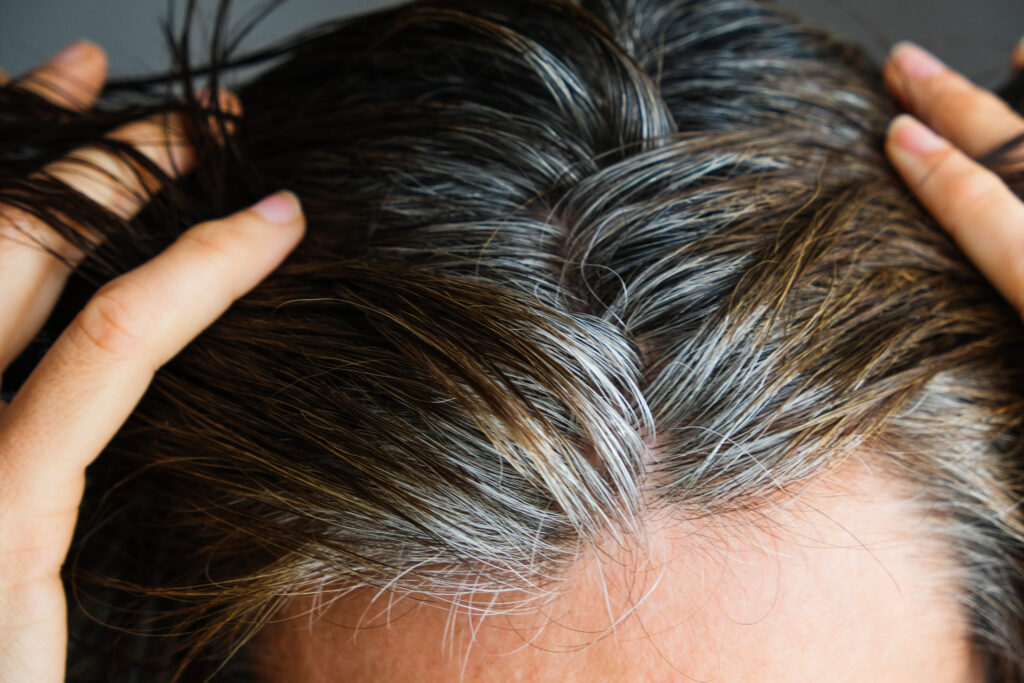
Grey grows in unevenly and in multiple shades. Some women get silver at the temples and hairline, some get scattered strands, some get a bold white streak at the crown. This shows up differently within each base color: black, brown, blonde, red, or years of layered color on top of any of those.
The variation in each person’s hair is why grey blending is a goal achieved over several sessions. The method depends on how much grey someone has, where it shows, what their base color is, and how much grey they actually want visible. A woman with dark permanent color and light grey roots manages a stronger visible contrast between appointments than a woman with highlighted blonde hair, whose existing color already mixes with silver and white. Texture, length, and hair condition all factor into what a colorist can realistically do. It’s this harder case, long dark hair with white roots, that carries the highest price tag, as the cost section below makes clear: more contrast to break up generally means more time in the chair and a higher price.
What It Costs and How Often You’ll Go to the Salon
Pricing varies more than most hair services because this is a category made up of multiple, often layered techniques. The market is the biggest driver of cost: a New York or Los Angeles salon may quote two to three times what a Midwest salon would charge for the same service. One woman we spoke to about the cost of her grey blending said her NYC salon quoted her $1,500 in a consult, for long, dark hair with white roots. Which technique is required for your hair is another cost driver: a straightforward gloss-based blend costs significantly less than a full balayage or multi-foil session. A full color correction may be needed first if there’s heavy old buildup or dark permanent color to work through.
The upside shows up in frequency. Standard root touch-ups run every four to six weeks. Once the initial blend removes that hard demarcation line, grey blending appointments space out to every ten to sixteen weeks, depending on how fast your hair grows. From there, it’s mostly a question of personal comfort: some women want less grey showing and book more often, others want to stretch the time between salon visits as long as possible.
Caring for Grey and Blended Hair
Grey hair runs drier and coarser than pigmented hair. Light grey and white strands also pick up yellow tones from heat, minerals, chlorine, sun, smoke, or product buildup quickly.
Your colorist should recommend a product routine tailored to your specific texture and the process, toner, or gloss they used. They can also advise on things to avoid, like chlorine, so the color doesn’t shift early. There might also be smaller in-between treatments, like a gloss that can extend the color’s vibrancy.
Deciding How Much Grey You Want
Grey and grey blending have become a style decision. You can start by letting a few silver strands show to see how it feels. You can try blending your color for a while and grow the rest out later. Or not. You can go back to full grey coverage if blending doesn’t work for you.
Stigmas surrounding aging and grey hair have been replaced by a multitude of hair color options. The shift has its own documentary by international hair and makeup artist Ilise Harris. “Your Roots Are Showing” frames grey hair acceptance as part of a larger movement tied to aging, visibility, and beauty standards.4
The decision to grey blend or go completely grey is the newest part of your midlife style strategy, whether you’re running errands or walking the runway.
Footnotes
- Vogue, “Gray Blending Is the Silver Hair Color Trend Colorists Are Loving” ↩
- Hairdressers Journal, “Grey Blending: Everything You Need to Know” ↩
- InStyle, “French Blending Is the Low-Maintenance, Laid-Back Approach to Coloring Gray Hair” ↩
- “Your Roots Are Showing”, directed by Ilise Harris ↩

There’s a daily ritual a surprising number of midlife women talk about, and a surprising number don’t admit to. The New York Times games have found their way into morning routines across the country, somewhere between the first cup of coffee and the official start of the day.
We’re sold on the idea that we need protein, weight-bearing exercise, to walk more, more fiber; there’s a list. And on that list, somewhere between don’t skip your annual mammogram and wear supportive shoes is keeping our brains sharp.
Nobody is entirely sure where they heard this was a good thing. A podcast, maybe, or something a doctor mentioned in passing. Somewhere along the way, the idea that word games are good for your brain became the kind of thing women in this life stage believe. Women in mavenhood are paying attention to their brains in a way they weren’t ten years ago. Whether the science fully backs it up is almost beside the point. The habit is already set. And then, almost perfectly timed, came a suite of free daily games that feel like mental exercise and take less than ten minutes.
Nobody posts a screenshot of finishing their fiber supplement. A Wordle solve in two is a whole other thing. These small victories, a Connections solved without any mistakes, a Mini completed in 20 seconds, have become a source of bragging rights for women who have long since outgrown report cards, standardized tests, and performance reviews. For a few minutes each morning, there’s a puzzle to solve, a score to compare, and occasionally, a reason to let the group chat know exactly how well things went.
There’s also that little thrill of feeling keyed in before the day starts. You start the day winning, at least in your mind. Yesterday’s time is a personal best waiting to be broken. At a stage of life when brain fog is a real and regular conversation, finishing the Spelling Bee at Genius level is its own form of reassurance. This is working. For a few minutes each day, there’s a problem with a solution.

The games have become a kind of ad-hoc membership card. Mention Wordle, Connections, Strands, or the Mini in the right company and chances are someone nearby recognizes you as a player. There are favorite games, least favorite categories, and most women have at least one story about a puzzle they couldn’t believe they missed. No preparation required.
On a recent road trip, while waiting for a food order at a roadside stand, one friend turned to another and asked, “Did you get the Wordle today?” This started a familiar conversation. What was the word? How many guesses did you get it in? Within a minute, another woman in line had jumped into this conversation with, “Are you talking about Wordle? I play every day.”
Another reason these games have caught on: multiple choice. Most of what women deal with in mavenhood doesn’t come with ready made answers. Which long term health care plan is the best? Should I get a second opinion on HRT? These aren’t nearly as cut and dried as: play this, help your brain.
These NYT puzzles, by contrast, are refreshingly straightforward. There is an answer. The Connections categories eventually reveal themselves, even if one of them turns out to be infuriating.
The lure of the daily puzzles is their nearly unicorn status: things that feel good and might be good for you, take ten minutes, have a clear beginning and end, offer some level of choice, and give you something to talk about. The New York Times stumbled on something in the middle of a pandemic. Women in mavenhood found it, and kept it.